Every boneless sofa and loveseat arrives compressed into a single manageable box — cut the bag, position it, and the foam expands on its own within 72 hours.
Tested capacities across the line run from 300 lbs on the swivel accent chairs to 1,400 lbs on the larger sectional configurations — numbers verified in product specs, not estimates.
Both fabric families resist pilling and light stains, and most models ship with removable covers — which matters more at month six than it does on unboxing day.
The compression process is reversible by design: every vacuum-packed Luxanimarion sofa fully recovers its shape and loft within 72 hours, and compressed appearance right after unboxing is normal, not a defect.
Luxanimarion's swivel accent chairs, sectional sofas, loveseats, and sleeper sofa bed are designed around the same constraint — they need to ship easy, set up fast, and look like they cost more than they do. The accent chair pairs naturally with any sectional in the lineup, and the loveseat shares the same corduroy fabric family as the sleeper sofa bed.
Luxanimarion's Swivel Barrel Accent Chair is a 360°-rotating, oversized barrel chair upholstered in teddy or chenille fabric — available in four colors and sized to work as a reading chair, vanity seat, or living room accent without requiring tools to use. ``` ```
Six configurations from 78" to 126" wide — most ship boneless and require zero assembly. Seat depths run 24.8" to 29.2", built for lounging rather than upright sitting.
One flagship model at 75" wide with a 25" seat depth and 1,000 lb weight capacity. Vacuum-packed into a single box. The highest review count in the Luxanimarion catalog at 221 ratings.
A fixed-frame corduroy sofa bed with a 78.5" × 37" sleep surface and 100% high-resilience foam construction. Rated 4.8/5 from 28 reviews — the highest rating in the lineup.
Browse the complete brand catalog with up-to-date pricing on Amazon.
These are the products that show up most often in repeat orders and first-time purchases — usually because a specific spec solved a specific problem, whether that was a narrow doorway, a studio layout, or needing two chairs without paying for two separate orders. The grid spans all four product lines.
Six sectionals, one coherent line — mostly boneless, all corduroy or chenille, built for rooms that need furniture to ship easy and look right. Five of the six arrive vacuum-packed with no assembly required; the 78" wood-frame model is the clear exception, with a 15-minute assembly and a 19.6" seat depth that's notably shallower than the rest of the line. Seat depths across the boneless majority run 24.8" to 29.2" — three to seven inches deeper than a standard sofa — which is the most important spec difference to understand before choosing a model.
The honest answer is that it depends on construction — specifically whether the sofa uses pure foam or foam with spiral spring reinforcement underneath. All-foam boneless designs do go flat over time; that's a documented complaint in furniture communities, and it's not unfair. What separates sofas that hold up from ones that don't is the foam density and whether there's a spring layer adding rebound that foam alone can't sustain.
Boneless construction means there's no rigid internal frame — no wood, no metal — holding the sofa's shape. The structure comes entirely from foam density and, in some models, coil springs embedded beneath the foam layer. This is why boneless sofas ship compressed: without a frame, the foam can be vacuum-packed down to a fraction of its finished size.
The durability risk is real and comes from one specific failure mode: all-foam designs that use low-density foam will compress under repeated use and not fully recover. When you sit in the same spot every night for six months, that section gets noticeably softer than the rest. This is what Reddit's r/furniture community means when they say boneless couches "lack structure, making it uncomfortable" — they're usually describing pure low-density foam sofas, not spring-reinforced ones.
The Luxanimarion sectional line uses 30D high-density foam in the 122" L-Shape Sectional Ottoman — that's a meaningfully higher density than budget all-foam competitors, which typically run 18D–22D. Higher density foam compresses less per use cycle and recovers more fully. It doesn't last forever, but the degradation curve is slower.
Every vacuum-packed Luxanimarion sectional needs 72 hours after unboxing to reach its full loft and shape. This is a compression recovery process, not a quality issue. The foam is physically compressed for shipping — sometimes for weeks — and it needs time to decompress and re-expand fully.
What this means practically: don't evaluate the sofa's comfort on day one. Don't sit in it heavily for the first 48 hours. Give it the full 72 hours in a temperature-stable room, then assess whether the cushions have fully expanded. If sections still look uneven at 72 hours, a hair dryer on low heat applied to the fabric (as specified in the product instructions) helps the foam relax faster.
Three habits extend the life of a boneless sectional more than anything else:
This is worth saying directly because it shows up in reviews from buyers who were surprised: the boneless sectional's seat depth of 26–29 inches and low profile of 26–27 inches high means the backrest hits mid-back at best, not upper back or shoulders. If your primary use case is sitting upright at a desk, eating on the sofa, or working from the couch regularly, this design will be uncomfortable within a few hours. The backrest won't reach where you need it.
The deep seat excels at exactly one thing: lounging. Watching TV lying back, reading sideways, having a nap. If that's 80% of how you use your sofa, the construction matches the use case well. If you need structured lumbar support, a traditional framed sofa with a taller backrest is genuinely the better call — the 78" L-Shape Wood Frame Sectional in the Luxanimarion line has a 33.46" back height, which is considerably taller than the boneless models.
The sectional line spans 78" to 126" wide — a 48-inch range that covers studios, standard apartment living rooms, and open-plan spaces with room to spare. The right model isn't about which one looks best in photos; it's about which one fits through your door when it arrives and doesn't leave you with four feet of dead space on one side once it's in place.
The 2/3 rule for sofas says the sofa should occupy roughly two-thirds of the wall it anchors — leaving visual breathing room on either side without the sofa looking undersized. In practice: a 12-foot (144") living room wall calls for a sofa around 88–100 inches wide. A 10-foot (120") wall works with a sofa around 72–90 inches. Use this as your starting filter before comparing models.
One thing to check before applying the rule: measure from where the sofa's far end will land (usually 4–6 inches off the wall) to the nearest doorway, hallway opening, or room transition. The sofa can't float in space — its footprint includes the chaise or ottoman end, and that end often extends into traffic paths in smaller apartments.
The 78" L-Shape Wood Frame Sectional is the only model in the line built for genuinely compact spaces. At 78.5" wide and 47.94" deep (with the ottoman positioned), it fits flush against two walls in a standard studio layout without consuming the room. The shallower 19.6" seat depth is actually a benefit here — deeper seats eat floor space, and in a studio every foot counts.
Worth noting: this is the one model with a wood frame and 15-minute assembly. It's also the one that doesn't ship vacuum-packed, so the box dimensions are closer to the finished sofa size. Confirm your elevator or stairwell can handle it before ordering.
This is where most of the boneless line lives. The 104" Curved Chaise Sectional (104" wide, 29.2" seat depth) and the 110" Curved Sectional Chenille (110" wide, 24.8" seat depth) both fit standard apartment layouts — roughly a 13–15 foot wall — without requiring an open-plan room.
The 114" Cloud Sectional Khaki pushes the upper edge at 114" wide; it works in this range but needs at least 13.5 feet of wall clearance to avoid crowding adjacent doorways. The vacuum-packed shipping on both models means the delivery box is substantially smaller than the finished piece — apartment-friendly, narrow-doorway friendly.
One decision point in this range: chaise orientation. The 104" model ships in both right-facing and left-facing versions. Stand in your room, picture where the chaise will face, and order accordingly. Reversing a chaise after the fact requires a return.
The 122" L-Shape Sectional Ottoman and 124" Curved Sectional 7-Pillow are built for rooms that can hold them. The 122" model clocks in at 39.4" deep × 122" wide, weighs 160 lbs, and includes an ottoman that extends the L into the room rather than against a wall — so plan for the ottoman footprint in your layout.
The 124" Curved Sectional 7-Pillow is the largest option at 126" wide and 50" deep. That 50-inch depth is significant — it will reach far into a room, and in anything under a 14×16 foot space it will dominate. It's the right call for an open-plan living area where the sofa is meant to anchor a large seating zone. It ships in two boxes, which may arrive on different days — keep that in mind for setup day.
All vacuum-packed boneless models ship in compressed boxes that are substantially smaller than the finished sofa. The 122" sectional, for example, ships at 160 lbs but arrives in a box narrow enough for a standard apartment doorway. Most standard apartment doors measure 32–36 inches wide — the compressed boxes clear that comfortably.
The 78" wood-frame model does not compress — its box is closer to full assembled size and should be checked against your narrowest doorway before ordering. Check the listed box dimensions on the Amazon product page, measure your narrowest point (usually the elevator interior, not the front door), and confirm before you buy. A returned sectional sofa is an expensive and logistically painful problem.
The honest answer to "will this go flat?" depends entirely on what's inside the sofa, not on whether it's boneless. Pure all-foam designs — foam only, no spring reinforcement — do compress and lose loft over time, especially under daily use. That's the construction being criticized in r/furniture threads and Wirecutter boneless couch tests. The key question isn't "is it boneless?" It's "what's the foam grade, and is there spring support underneath?"
Foam density is measured in pounds per cubic foot. 30D means 30 lbs per cubic foot — that's a commercial-grade density, meaningfully higher than the 18–22D foam found in budget boneless designs that buyers on Reddit are typically describing when they say their cloud couch flattened in three months. Higher density foam compresses less under load and returns to shape faster. The 122'' L-Shape Sectional Ottoman explicitly uses 30D high-density foam with fast-rebound technology — that's a specific, verifiable construction detail, not a marketing line.
The 114'' Cloud Sectional Khaki uses polyester and memory foam with removable covers. Memory foam behaves differently from high-resilience foam: it molds to your shape under pressure and recovers slowly — you'll see the impression for a few minutes after you stand up. That's not a defect, it's how memory foam works. High-resilience foam (the type in the other sectionals and the loveseat) snaps back immediately. Neither is universally better — but they feel different, and buyers who expect one and get the other are often surprised.
Every vacuum-packed sectional in the Luxanimarion lineup — the boneless models — arrives compressed and needs time to decompress. Full loft restores within 72 hours after unboxing. What this looks like in practice: the sofa comes out of the bag looking dense and compressed, sometimes slightly uneven. Over the next two to three days, the foam expands to its intended shape. Buyers who don't know this sometimes assume they received a damaged product. They didn't — it's the compression process working correctly.
During those 72 hours, you can sit on the sofa. But don't evaluate the comfort or firmness until it's fully restored. The final feel is noticeably different from the out-of-box state.
No foam sofa — boneless or framed — maintains its shape indefinitely without any maintenance. Here's what extends the life of these pieces:
Every sectional in this line — except the 78'' L-Shape Wood Frame Sectional — has a seat depth of 23" to 29.2", compared to the 19–22" standard for most traditional sofas. The backrest heights are correspondingly low. What this means in practice: you're going to be leaning back, not sitting upright. Your back won't make contact with the backrest in an upright posture on most of these models — there's too much seat in front of you.
For TV watching, lounging, gaming, or reading in a reclined position, this is exactly right. For someone who primarily works from the sofa or needs firm lumbar contact while sitting upright, it's the wrong design — and that's worth knowing before purchasing, not after. The 78'' L-Shape Wood Frame Sectional is the exception here: with a 19.6" seat depth and a 33.46" backrest height, it supports upright sitting more naturally and is a different product for a different use case.
The Luxanimarion sectional line spans 78" to 126" wide — a 48-inch range that covers studio apartments through large open-plan living rooms. The right model comes down to three measurements: your room's usable width, your narrowest doorway or hallway, and whether you want a left-facing or right-facing chaise. Getting these right before ordering saves a return.
The general design guideline — your sofa should occupy roughly two-thirds of your wall's length — gives you a rough room-size target. For a 10-foot wall (120"), a sectional in the 78"–90" range fits the rule. For a 14-foot wall (168"), a 110"–122" sectional works. But this is a starting point, not a hard rule: sectionals also need clearance on the chaise end and enough open space for comfortable movement through the room.
More practically: measure the longest wall in your living room, subtract 18–24 inches on each end for breathing room, and use the result as your maximum sectional length. Then check the depth — the boneless models range from 23.2" to 50" deep depending on the model, and depth is often where people get surprised.
The 78'' L-Shape Wood Frame Sectional (B0GHQN6HRD) is the right answer for genuinely tight spaces. It's 47.94" deep and 78.5" wide — compact enough for a studio bedroom or a small apartment living room where a 110"+ sectional would dominate the floor plan. Unlike the boneless models, this one has a wood frame, 15-minute assembly, and a 19.6" seat depth. It's a different product category inside the same brand — more traditional construction, more upright seating posture, and a 685 lb weight capacity across three seats. Washable covers and a reversible ottoman add flexibility. If you specifically want boneless construction at this size, the 75'' Cloud Loveseat Corduroy is closer — it's not technically a sectional, but at 75" it serves the same spatial purpose.
The 104"–114" range covers most standard apartment living rooms — typically rooms in the 12×14 to 14×16 foot range.
The 104'' Curved Chaise Sectional (B0F4XQKHZR) is 104" assembled with a 29.2" seat depth — one of the deepest in the lineup. It includes three large back pillows and two decorative throw pillows, and it's available in right-facing or left-facing chaise configurations. Choose based on which direction puts the chaise against the wall with the most clearance. The corduroy upholstery is a warmer, more textured look than chenille.
The 114'' Cloud Sectional Khaki (B0GHYN21MK) is 114" wide and 23.2" deep — the shallowest of the boneless sectionals, which can work in a narrower room where the extra depth of the 104" or 122" models would eat too much floor space. It uses memory foam rather than high-resilience foam, and the removable covers make it the most maintenance-friendly model for households with kids or pets. Multi-box delivery means the boxes arrive separately — typically on the same day, occasionally on different days.
The 122'' L-Shape Sectional Ottoman (B0FL25R91R), the 110'' Curved Sectional Chenille (B0H6FZG25W), and the 124'' Curved Sectional 7-Pillow (B0GXFRN5KY) are built for rooms where a smaller sectional would get lost.
The 122'' L-Shape arrives at 122" wide and 39.4" deep with a separate ottoman included — the total footprint is larger than the listed dimensions once you account for ottoman placement. It uses 30D high-density foam and seats four, with a 4.3/5 rating from 82 reviews — the highest review count in the sectional line.
The 124'' Curved Sectional 7-Pillow is the largest option at 126" wide and 50" deep. It seats five and carries a 1,200 lb weight capacity — the highest in the lineup. The listed 17" seat depth in the spec table appears inconsistent with the 50" overall depth; the actual seating area is deeper than a 17" figure would suggest. It arrives in two boxes specifically sized to fit through standard doorways. The curved silhouette is the most visually distinct shape in the lineup.
The 110'' Curved Sectional Chenille sits between those two at 110" wide and 25" deep, with a 24.8" seat depth and 17" seat height — the tallest seat in the boneless sectional group, which makes it slightly easier to stand up from than the lower-profile models.
On models that offer this choice (notably the 104'' Curved Chaise Sectional), "right-facing" means the chaise extends to the right when you're standing in front of the sofa looking at it. Most people find it easier to figure out by sketching their room layout: draw your sofa position, draw the wall it backs up to, then determine which direction gives the chaise more clearance and better traffic flow. If the chaise is on the left and you're constantly walking past it to reach a doorway, you probably want right-facing — and vice versa.
The boneless sectionals ship vacuum-packed and compressed — the boxes are substantially smaller than the assembled dimensions. The 124'' Curved Sectional 7-Pillow ships in two separate boxes specifically to navigate narrow doorways. Most apartment doorways are 32–36" wide; these compressed boxes are designed to clear that. But check your specific listing's box dimensions before ordering, particularly if you have a building elevator with a tight interior or a hallway with a sharp turn. The wood-frame 78'' model ships differently — it's not vacuum-packed, so the box dimensions are closer to the assembled size.
There's one loveseat in the Luxanimarion lineup — the 75" Cloud Loveseat Corduroy — and with 221 reviews at 4.5/5, it's the most-reviewed product in the entire catalog. The specs explain why it gets attention: 25" seat depth (three to five inches deeper than a standard loveseat), 1,000 lb weight capacity, and a vacuum-packed single-box delivery that fits through any standard apartment door. It ships in corduroy, arrives medium-firm, and requires zero assembly. Available in multiple colors including beige, black, grey, and brown.
The 75" Cloud Loveseat is genuinely good at specific things and genuinely wrong for others. The 25" seat depth and low-profile backrest are intentional design choices — not shortcuts — and they either match how you use a sofa or they don't. Knowing which category you're in before ordering saves a difficult return on a 90-pound piece of furniture.
The 25-inch seat depth is the defining spec. A standard loveseat runs 20–22 inches deep — this one runs 3 to 5 inches deeper, which is the difference between sitting and lounging. If you spend most of your sofa time watching TV lying back, reading sideways, or just sitting with your legs tucked up, that extra depth is exactly what you want. Your legs have room to extend without hanging off the edge.
The backrest is low. Total height is 28 inches, seat height is 16 inches — so the backrest covers roughly 12 inches of your back. For most people sitting upright, that reaches mid-back at best. Walmart reviewers noted "back support is pretty low, arm rests are pretty shallow and flimsy," and Reddit users in r/ApartmentHacks confirmed "it doesn't have an actual back rest/arm rest" in the traditional sense. These aren't complaints about defects — they're accurate descriptions of what this sofa is.
Standard sofas run 20–22 inches deep from front edge to backrest. Three to five extra inches doesn't sound like much until you're sitting in it. At 20 inches, your back naturally contacts the backrest when sitting upright. At 25 inches, there's a gap — you either lean back into the cushion and lounge, or you sit at the front edge of the seat without using the backrest at all.
This is why the loveseat has 221 reviews and consistently positive feedback from loungers, and occasional criticism from people who sit upright. Both groups are right about what they experienced. The question is which group you belong to.
One honest note on armrest depth: at 38 inches total sofa depth, the armrests are not oversized. They're functional but not wide enough to use as a surface. If you want to set a drink or a book on the armrest while seated, it'll slide. That's a real limitation of the design at this depth-to-armrest ratio.
At 75 inches wide (just over 6 feet), this loveseat fits two adults comfortably for watching TV and can accommodate one adult sleeping lengthwise if they're under about 5'9". A couple sharing the sofa for a movie has enough width without being crowded. A family of four does not — that scenario needs the sectional line.
For studios under 300 square feet, 75 inches is often the right call: narrow enough to leave the room functional, wide enough to seat two. Pair it with one of the swivel accent chairs from the Luxanimarion lineup and you have a full seating arrangement without surrendering the entire floor plan.
The 75'' Cloud Loveseat Corduroy is a specific tool for a specific buyer. At 25" seat depth, 16" seat height, and a low, cushioned backrest, it's built for lounging — not for upright sitting. Understanding who that benefits (and who it frustrates) before purchasing saves a return, and the review record is honest enough about both sides.
Standard sofas run 20–22" seat depth. The 75'' Cloud Loveseat Corduroy runs 25". That extra 3–5 inches is why this sofa feels different from almost everything in a traditional furniture showroom — and why buyers who've only ever owned standard sofas sometimes need a few days to adjust. The 16" seat height is also slightly lower than average; combined with the deep seat, you're closer to a lounging position than a dining-chair position from the moment you sit down.
For the buyer who's been on Reddit looking for a "deep seat sofa for lounging" — this is that sofa. For the buyer who filtered for "loveseat under 80 inches" without reading the seat depth spec, it's going to feel different than expected. Check the 25" figure against your current sofa's seat depth before ordering.
Two adults fit comfortably side by side. A verified Reddit thread from r/ApartmentHacks confirms it works for both a 5'0" and 6'0" person simultaneously — the 75" width accommodates the height difference without crowding. Seating capacity is listed as two. It can seat three in a pinch — the weight capacity is 1,000 lbs — but it's a snug three, not a comfortable one for extended periods.
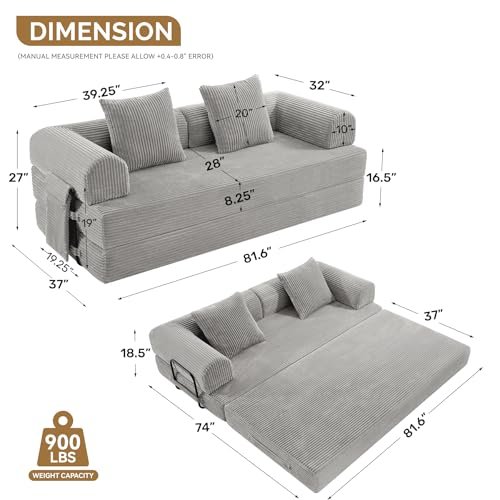
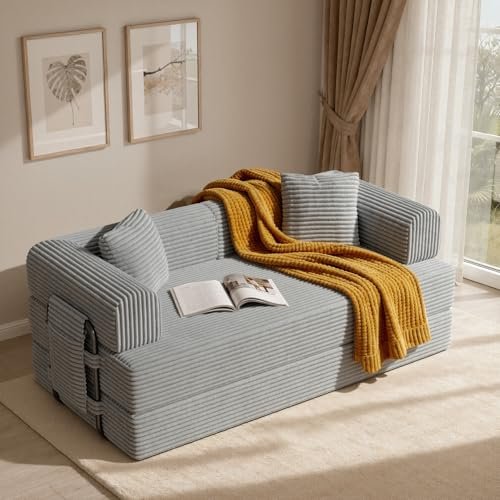
The Corduroy Sleeper Sofa Bed is the only model in the sleeper line, and it's different from every other Luxanimarion sofa in one critical way: it uses a fixed-shape frame rather than boneless construction. That matters for sleeping — a fixed frame means the sleep surface doesn't shift or compress unevenly the way an all-foam boneless design can. The sleep surface runs 78.5 inches wide by 37 inches deep, uses 100% high-resilience foam (no springs, no sharp edges), handles up to 900 lbs, and ships with a mattress and three cylindrical pillows. Currently rated 4.8/5 from 28 reviews — the highest rating in the Luxanimarion catalog.

The short answer: it handles nightly use better than most boneless foam sofas in this price range, specifically because it has a fixed-shape frame. That structural decision — the one thing that makes it different from every other Luxanimarion sofa — is also what makes it a realistic option for regular sleeping rather than occasional guest overflow. But there are honest limits to what any foam-only sofa bed delivers compared to a dedicated mattress.
Most boneless sofas — including the Luxanimarion sectional and loveseat lines — have no rigid internal structure. Shape and support come entirely from foam density. That's fine for sitting and lounging, where you're not sustaining full body weight in one position for 7–8 hours. For sleeping, it's a different story: an all-foam boneless surface without frame support can develop uneven compression zones over weeks of nightly use, and once a section flattens, the surrounding foam doesn't compensate.
The Corduroy Sleeper Sofa Bed uses a fixed-shape frame underneath the foam. That frame holds the sleep surface geometry consistent under repeated nightly use — the foam compresses and recovers, but it's compressing against a stable base rather than settling into itself. The product specs confirm 100% high-resilience foam construction with no springs and no sharp edges, and a 900 lb weight capacity that's engineered for sustained load rather than occasional use.
The flat sleep surface measures 78.5 inches wide by 37 inches deep. To put that in context: a standard twin mattress is 38" × 75", a full is 54" × 75", and a queen is 60" × 80". The Luxanimarion sleeper bed is wider than a twin but shallower than any standard mattress length — at 37 inches of depth in sleeping configuration, a person taller than about 5'10" will find their legs extending past the surface.
One adult sleeping on their side or back: works well within those dimensions. Two adults: possible but tight — 78.5 inches of width is sufficient for sharing, but 37 inches of depth means both people need to sleep relatively straight. Anyone who sleeps diagonally or curls significantly will run into the edges.
Be honest with yourself here. High-resilience foam is better quality than standard polyurethane foam — it recovers its shape after compression rather than holding an impression — but it's still foam on a flat surface, not a coil-spring or hybrid mattress with pressure-zone support. People who sleep well on firm foam beds, camping pads, or floor mattresses will adapt to this quickly. People who need specific lumbar support, a softer sleeping surface, or zoned firmness will notice the difference from a dedicated mattress within a few nights.
For occasional guest use — a few nights a month — the construction is more than adequate, and 4.8/5 from 28 reviews confirms buyers are satisfied. For true primary nightly use by someone who struggles with back pain or needs a specific sleep surface, it's worth setting realistic expectations: this is a quality sofa bed, not a mattress substitute.
The sofa converts to sleeping mode by repositioning the three included cylindrical pillows — they serve as backrest support in sofa configuration and lay flat as part of the sleeping surface or alongside it when the sofa flattens out. There's no pull-out mechanism, no handle, no hidden mattress folded inside the frame. The conversion is the physical act of repositioning the pillows and adjusting the backrest angle.
That's genuinely simple, which makes daily conversion practical in a way that traditional pull-out sleeper sofas — with their metal frames and stored mattresses — often aren't. The trade-off is that you're not getting an additional hidden mattress layer; the foam seat cushions are the sleeping surface. If you'd be converting this sofa every single night, the ease of that process is a real advantage over a pull-out mechanism that gets stiff over months of use.
The 28" seat height in sofa mode and 16.5" seat height in relaxed mode give you a sofa that reads and functions normally during the day — it doesn't look like a guest-room cot waiting to unfold.
The Corduroy Sleeper Sofa Bed is built for more than occasional guest visits — but whether it handles nightly use depends on what you're comparing it to. The fixed-shape frame construction is what makes the difference between this product and using a boneless sectional as a sleep surface. The sleep platform here doesn't compress unevenly or shift during the night because there's an actual structural frame behind the foam, not just foam density holding a shape.
Most of Luxanimarion's line is boneless — no rigid internal frame, shape maintained by foam density and compression. That works well for daytime seating and occasional sleeping. For regular nightly use, a fixed-shape frame matters because it maintains dimensional consistency. The sleep surface stays flat, the foam compresses evenly under body weight, and you're not waking up to find you've sunk into a depression in the foam that's shifted overnight.
The Corduroy Sleeper Sofa Bed uses a fixed-shape frame combined with 100% high-resilience foam — no springs — throughout the seat cushions, backrests, and the three included cylindrical pillows. The lack of springs actually simplifies the construction: no coil creaking, no spring edge to roll off of, no pressure points from coil hardware under the foam. The 900 lb weight capacity covers the full unit, not per seat.
The sleep surface is 78.5" wide × 37" deep. That's wide enough for a single adult of any height — 78.5" is 6'6.5", which exceeds the length of most mattresses — but the 37" depth is narrower than a twin mattress (38") and considerably narrower than a full (54"). A single adult sleeper fits. Two adults would be very tight. The product is designed as a solo sleep surface or a comfortable guest situation for one person.
A dedicated twin mattress provides about 1" more width and comparable length. The difference in sleep quality between this foam surface and a budget innerspring mattress is probably negligible for most people. The difference between this and a mid-range memory foam mattress is real — a purpose-built mattress at 8–12" thickness will sleep better than a 27"-tall sofa that converts to a flat surface.
If "nightly use" means you're using this as a primary bed for six months while your apartment is being renovated — it'll hold up structurally, but it's not going to feel like a proper bed. The foam is high-resilience and doesn't have the progressive support layers a designed mattress uses. You'll sleep fine; you probably won't sleep as well as you would on a mattress.
If "nightly use" means you have a studio apartment, you sleep on the sofa every night because there's no separate bedroom, and you want something that doesn't develop a permanent body impression after 60 days — that's exactly the use case this product handles. The high-resilience foam returns to shape after compression. The 4.8/5 rating from 28 reviews is the cleanest signal in the lineup; with a small review count like that, a few bad experiences would drag the average down noticeably, and they haven't.
The sofa doesn't fold out like a traditional sleeper — there's no pull-out mattress mechanism. The cushions lay flat as the sleep surface directly. The three cylindrical pillows included serve as bolsters or can be repositioned depending on how you're using the sofa. Setup involves rearranging cushions rather than deploying a fold-out frame. That's simpler, but it also means you're sleeping on the same foam you sit on during the day — there's no separate mattress that stays protected while the sofa is in use.
For people who convert the sofa to a bed every night and back every morning, the cylindrical pillow system is easier than a traditional fold-out mechanism. No metal frame to pull, no mattress to drag out. For people who want a completely flat, firm sleeping surface that feels nothing like a sofa cushion, a traditional pull-out with a separate innerspring mattress will feel more like a conventional bed — at the cost of considerably more moving parts and setup complexity.
The right Luxanimarion piece comes down to four questions: How much floor space do you have? Do you need primary seating, an accent piece, or both? How important is no-assembly delivery? And does anyone need to sleep on it? Answer those honestly and the decision tree below gets you to the right line quickly.
Choose the swivel barrel accent chair if you're completing a living room that already has a sofa — or if you need a standalone seat for a bedroom, home office, or reading corner. The barrel chair measures 23" wide × 29" tall, assembles in about 10 minutes with four screws, and handles up to 300 lbs on its FSC-certified wood frame. The 360° rotating base is what separates it from a static accent chair: you can face the TV, face a conversation partner, or face a window without shifting the chair itself. It's not a primary sofa replacement — the 21.5" seat depth is designed for upright to slightly reclined sitting, not for lounging for hours at a stretch. If your goal is a stylish secondary seat that earns its square footage, this is it.
Choose the 75'' Cloud Loveseat if you're furnishing a studio apartment, a bedroom, or any room where a full sectional is too much. At 75" wide and 25" deep, it fits through standard apartment doorways in its vacuum-packed box, requires zero assembly, and seats two adults comfortably — or one person who prefers to sprawl sideways. The 1,000 lb weight capacity is unusually high for a two-seater in this class. One honest note: the backrest is lower than a traditional sofa's, and the armrests are relatively shallow. If you need strong lumbar contact while sitting upright, this specific design works against you. If you watch TV lying back, read curled up, or want the closest thing to a daybed with a sofa silhouette, it makes sense.
Choose a sectional if the loveseat is too small and you have the floor space for it. The Luxanimarion sectional line runs from the 78'' L-shape (wood-framed, 19.6" seat depth, 15-minute assembly — the exception in an otherwise boneless lineup) up to the 124" curved premium with 1,200 lb capacity and 7 included pillows. Five of the six sectionals are boneless and require no assembly; seat depths across those five range from 23.2" to 29.2", all of them deeper than the 20–22" industry standard. The right size depends almost entirely on your room — a dedicated sizing guide below maps room dimensions to specific models.
Choose the Corduroy Sleeper Sofa Bed if you need a sofa that reliably converts to a sleeping surface — not a sectional that can technically work as a bed, but a piece built from the ground up to do both. The sleeper sofa has a fixed-shape frame (unlike the boneless sectionals), a 78.5" × 37" sleep surface, and 100% high-resilience foam throughout. It holds up to 900 lbs. The difference between this and using a boneless sectional as a sleep surface is structural: the fixed frame means the sleeping platform doesn't shift or compress unevenly during the night. If the sleep function is occasional — a few times a year for guests — any of the sectionals will work. If it's weekly or nightly, the sleeper sofa's construction is the right call.
We picked this video because Nicole DelaCruz asks exactly the right question — not 'what fits?' but 'what works?' You'll see how a well-chosen accent chair adds seating and personality without eating the floor plan alive. If you're trying to figure out whether a swivel barrel chair or a slimmer profile makes more sense for your space, this walkthrough gives you a practical framework for making that call before anything ships to your door.
"I've had the Swivel Barrel Chair Caramel Set in my living room since spring and the swivel is still smooth — no wobble, no grinding. My husband is 6'3" and actually commented on how solid it felt, which I did not expect. My one note: the teddy fabric reads warmer and richer in person than it does in listing photos, so if you're trying to match a cool-toned room, check real user photos first."— Tonya H., Aesthetic-Conscious Upgrader furnishing a new home, on swivel accent chair
"Set up the Swivel Barrel Chair 2PCS Chenille in about 20 minutes total for both chairs — four screws each, instructions were clear enough. They hold 300 lbs each, which mattered to me. The chenille fabric isn't as plush as the teddy versions but it wipes down much easier, which is the tradeoff I wanted. Exactly what I needed to fill two corners in my open-plan apartment."— Eugene P., First Apartment Buyer working with limited floor space, on swivel accent chair
"The 122'' L-Shape Sectional Ottoman arrived in one box, which I genuinely didn't believe until I saw it. Gave it the full 72 hours to expand — by day three it was fully lofted and the chenille felt noticeably more substantial than I expected at this size. Real talk: the 26.8-inch seat depth is very deep. I'm 5'5" and I need a throw pillow behind my back to sit upright. For lounging sideways, though, it's exactly right."— Linda H., Remote Work Home Refresher splitting sofa between video calls and movie nights, on sectional sofa
"Bought the 114'' Cloud Sectional Khaki for our basement media room. The removable covers sold me — I've already washed them twice and they came out fine. The memory foam does feel different from the HR foam models: a little slower to rebound, which I actually like for long movie sessions. Took three separate delivery days for all the boxes, so plan for that. Worth it once everything arrived."— Marcus D., Remote Work Home Refresher setting up a dedicated lounge space, on sectional sofa
"I ordered the 75'' Cloud Loveseat Corduroy for my studio bedroom — it fits the space perfectly and the beige corduroy photographs exactly like the listing, which almost never happens. The 25-inch seat depth means you're really lounging, not sitting up straight. I knew that going in from the specs, but if you need actual back support for work, this isn't the piece. For TV watching and reading curled up, I haven't found anything I like more at this size."— Priya S., First Apartment Buyer in a 400-square-foot studio, on loveseat sofa
"The Corduroy Sleeper Sofa Bed now lives in my guest room and doubles as a reading spot the rest of the year. The fixed frame makes a real difference — it doesn't sink or shift the way I expected a floor sofa to. My sister slept on it for four nights over the holidays and didn't complain once, which is the only metric I care about. The 78.5-inch width is enough for an adult to sleep without folding. I'd describe it as firm-comfortable, not hotel-mattress comfortable, so set expectations accordingly."— Renee T., Guest-Room Problem Solver needing dual sofa and sleep surface, on sleeper sofa bed
Yes, for most living room setups. The Swivel Barrel Chair line uses an FSC-certified wood frame, handles up to 300 lbs per chair, and assembles in roughly 10 minutes with included hardware. The 360° swivel makes it genuinely more useful than a static accent chair — you can reorient without moving the piece. Not worth it if you need armrests or a deep recline, since the barrel design doesn't offer either.
The main limitations are size and support. At 23 inches wide and 21.5 inches of seat depth, Luxanimarion's barrel chairs are compact — comfortable for one person but not a lounging piece. The curved barrel backrest wraps around the sides rather than supporting the lower back, so extended work sessions aren't its strength. For reading, conversation, or accent use, it works well. As a primary work chair, it doesn't.
Neither rule is absolute, but contrast tends to work better than matching. Pairing a caramel or beige swivel chair against a grey or darker sectional gives the chair visual presence without competing. The Luxanimarion barrel chairs come in caramel, beige, grey, and green — the caramel and beige colorways read warmer in person than in listing photos, which is worth accounting for when coordinating with a cool-toned sofa.
Straightforward. The barrel chair ships with all tools and instructions — assembly involves attaching the rotating base with four screws. Most buyers report finishing in 10 minutes or less. The swivel chairs are the only products in the Luxanimarion line that require any assembly; the sectionals, loveseat, and sleeper sofa bed all arrive ready to use after the foam restoration period.
Usually because the all-foam boneless design felt too soft after a few months — a real problem with budget foam-only models. Luxanimarion's 122'' L-Shape Sectional uses 30D high-density foam with fast-rebound technology, which is more durable than standard polyurethane foam. The models that go flat fastest are pure all-foam with no spring reinforcement and low foam density ratings. If long-term support matters to you, check the foam spec and ask whether a given model has spring reinforcement before buying.
The 2/3 rule says your sofa should occupy roughly two-thirds of your room's main wall — a useful starting point for sizing. In practice: a 12-foot wall works best with a sectional in the 96–112-inch range, which maps to Luxanimarion's 104'' Curved Chaise Sectional or 110'' Curved Sectional Chenille. Larger open-plan rooms with 15-foot walls can take the 122'' or 124'' models without overwhelming the space.
72 hours is the standard restoration window across all vacuum-packed models — the 122'' L-Shape Sectional, 104'' Curved Chaise Sectional, 110'' Curved Sectional Chenille, and 114'' Cloud Sectional Khaki all follow this timeline. The sofa will look compressed and possibly uneven for the first day or two. That's the foam decompressing, not a defect. Avoid sitting on it heavily during the first 72 hours to let the foam reach full loft.
All the vacuum-packed boneless models ship in compressed boxes sized to fit through 32–36-inch doorways — the assembled dimensions don't reflect the box size. The 124'' Curved Sectional ships in two boxes, which actually makes tight doorways easier to navigate. The 78'' L-Shape Wood Frame Sectional ships in a single box but requires 15 minutes of assembly after delivery. Check the Amazon listing's box dimensions against your narrowest passage before ordering any model.
Not for most two-person households. The 75'' Cloud Loveseat Corduroy seats two comfortably with a 25-inch seat depth — deeper than a standard sofa's 20–22 inches — so two adults can sit side by side without feeling cramped. If both people are over 6 feet or you want to stretch out lengthwise, the 75-inch width gets tight. For those situations, the 77-inch variation or the step up to a full sectional makes more sense.
Two adults comfortably. The 75'' Cloud Loveseat Corduroy is rated for a weight capacity of 1,000 lbs and lists a seating capacity of two. The 25-inch seat depth gives each person more front-to-back room than a typical loveseat, which helps — but the 75-inch width doesn't leave room for a third adult in any realistic arrangement. One user on Reddit noted it fits both a 5-foot and a 6-foot person without issue, which tracks with the dimensions.
The Corduroy Sleeper Sofa Bed (B0FB3MS9BF) is the most viable option for regular sleep use. It has a fixed-shape frame rather than boneless construction — which means it maintains its sleeping surface without sagging — and uses 100% high-resilience foam rated up to 900 lbs. The sleep surface measures 78.5 inches wide by 37 inches deep. It's firm-comfortable rather than mattress-comfortable, so it works well for occasional nightly use or guest stays of up to a week, but it won't replace a dedicated mattress for someone sleeping on it 365 nights a year.
Luxanimarion built its catalog around a specific problem: furniture that's genuinely difficult to get into apartments. Not just heavy or bulky — the kind that requires a crew, a service elevator booking, and three trips up the stairs only to find the piece won't turn the corner. The boneless construction that defines the loveseat sofa and sectional sofa lines came directly from that problem. No rigid frame means the foam compresses, ships in a manageable box, and expands on its own within 72 hours. The 75'' Cloud Loveseat Corduroy was among the earliest expressions of that thinking — 221 reviews later, it's still the highest-reviewed product in the lineup.
The sectional sofa line grew from the same philosophy but applied to bigger spaces and bigger households. Six distinct models now span from a compact 78-inch wood-frame L-shape with washable covers to a 124-inch curved sectional with 1,200-lb weight capacity and 7 included pillows. Not all of them are boneless — the 78'' L-Shape Wood Frame Sectional uses a traditional wood frame and requires 15 minutes of assembly — but the majority arrive vacuum-sealed and pop into shape without tools. The swivel accent chair line came later, addressing a different but related gap: what do you put in the corner next to a cloud sofa? The barrel chair, with its FSC-certified wood frame, 360° rotating base, and 10-minute assembly, answers that question for living rooms, reading nooks, and bedrooms. And the sleeper sofa bed rounds out the lineup for the guest-room problem — a fixed-shape frame with 100% high-resilience foam and a 78.5-inch sleep surface that converts without mechanisms or awkward pull-out hardware.
What ties all four lines together isn't a single material or a single price point. It's the premise that furniture should arrive ready to use, fit the spaces people actually live in, and hold up past the first six months. The corduroy and chenille fabrics across the sectional, loveseat, and sleeper lines are removable and washable on most models. The swivel chairs handle up to 300 lbs on an FSC-certified frame. The larger sectionals are rated for 1,000 to 1,400 lbs. Those are specifics, not slogans — and that's the kind of brand Luxanimarion is trying to be.
Here's what you actually need to know before buying — no marketing speak, just specs and honest trade-offs.
All Luxanimarion products — swivel accent chairs, sectional sofas, the 75'' Cloud Loveseat Corduroy, and the Corduroy Sleeper Sofa Bed — are sold through the official Luxanimarion store on Amazon. Visiting the store page shows the current full catalog across all four lines, including color and size variations not always visible in individual product listings.
For order questions, delivery issues, or product concerns, contact Luxanimarion directly through Amazon's buyer-seller messaging system. Support is consistent across all product lines — swivel chairs, sectionals, loveseat, and sleeper sofa bed are all handled through the same channel. When reaching out, include your order number and the ASIN of the specific product for the fastest response.
Luxanimarion products include a limited warranty, as noted in the product specs across the line. For warranty claims and return eligibility, refer to the specific product listing on Amazon and Amazon's standard return policy for furniture. The 72-hour foam restoration window applies to all vacuum-packed pieces — allow the full expansion period before initiating a claim for shape-related concerns.